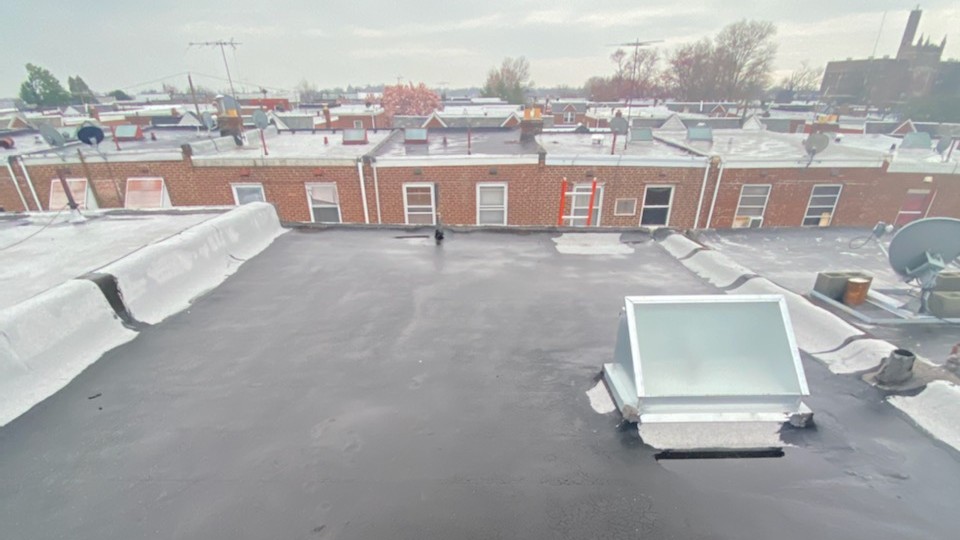
If your Philadelphia rowhome has a flat roof covered in overlapping rolls of asphalt-based membrane, often with a granular or silver-coated surface, it is probably a torch-down roof, also called modified bitumen. Like any flat roof, it needs regular attention to keep water out.
This guide is for owners of an existing torch-down roof: how long it tends to last, the problems to watch for, and when to repair, recoat or replace. If you already have a leak, start with our page on flat roof repair in Philadelphia.
Who can repair or replace the flat roof on a Philadelphia rowhome?
Union Roofing repairs and replaces flat roofs on Philadelphia rowhomes, including modified bitumen, EPDM rubber and TPO roofs. The company works from its Northeast Philadelphia office at 12260 Townsend Road, offers free estimates, and can be reached at (215) 464-6425 to book a flat roof inspection.
That includes the flashing where your roof meets the neighboring homes and party walls. For more on the material itself, see our modified bitumen roofing page.
Union Roofing offers a range of flat roof solutions for Philadelphia rowhomes. After a free inspection, it will recommend the best course of action for your roof and your budget.
What is a torch-down (modified bitumen) roof?
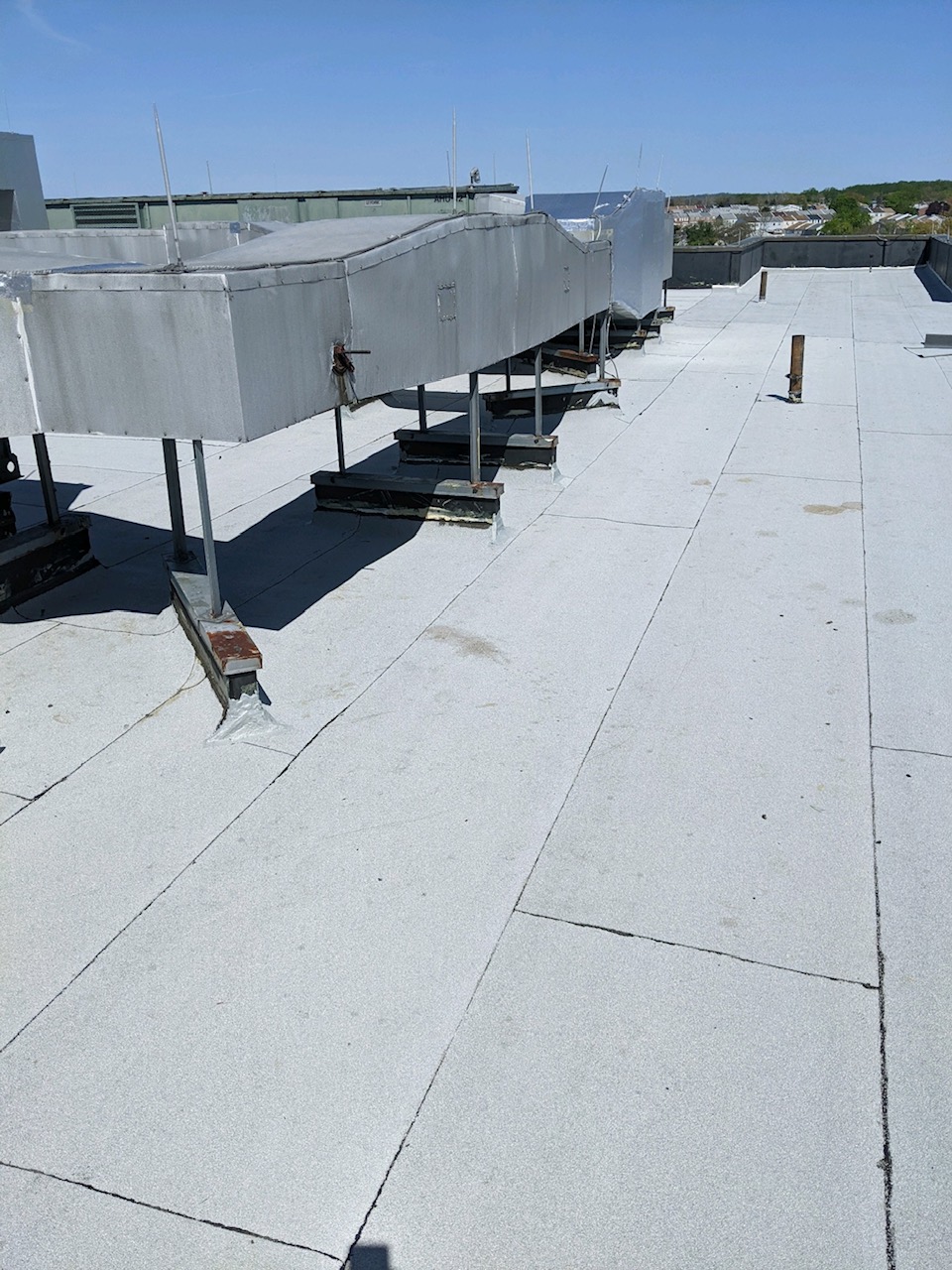
A torch-down roof is a modified bitumen roof. According to the manufacturer Polyglass, modified bitumen is made by adding polymers to asphalt and combining it with a fiberglass or polyester reinforcement. It comes in rolls laid in overlapping layers. “Torch-down” describes one way of installing it: heating the membrane so it bonds to the roof.
There are two main types. Polyglass describes APP membranes as plastomeric, which makes them more rigid once applied, and SBS membranes as elastomeric: more flexible, and able to tolerate much lower temperatures.
Despite the name, roofers apply modified bitumen in several ways:
- Torch-applied (heat-welded): the underside of the roll is heated until the asphalt melts, then rolled into place.
- Self-adhered: a sticky backing goes down as a release film is peeled away. CertainTeed sells its self-adhered system with the line “No fumes, no flame, no kettle.”
- Cold-applied: the membrane is set into an adhesive spread on the roof.
- Hot-mopped: some SBS membranes are set in hot asphalt.
Polyglass still lists heat-welding for both types, so torch-down remains in use. Because it means an open flame on top of a home, it is work for a trained, insured roofer, never a DIY job.
Why do so many Philadelphia rowhomes have a torch-down roof?
Most Philadelphia rowhomes have flat or low-slope roofs, edged by parapet walls and often sharing a continuous roofline with the homes next door. With so little slope, these roofs need a waterproof membrane rather than shingles, and modified bitumen is one of the common choices, along with EPDM rubber and TPO.
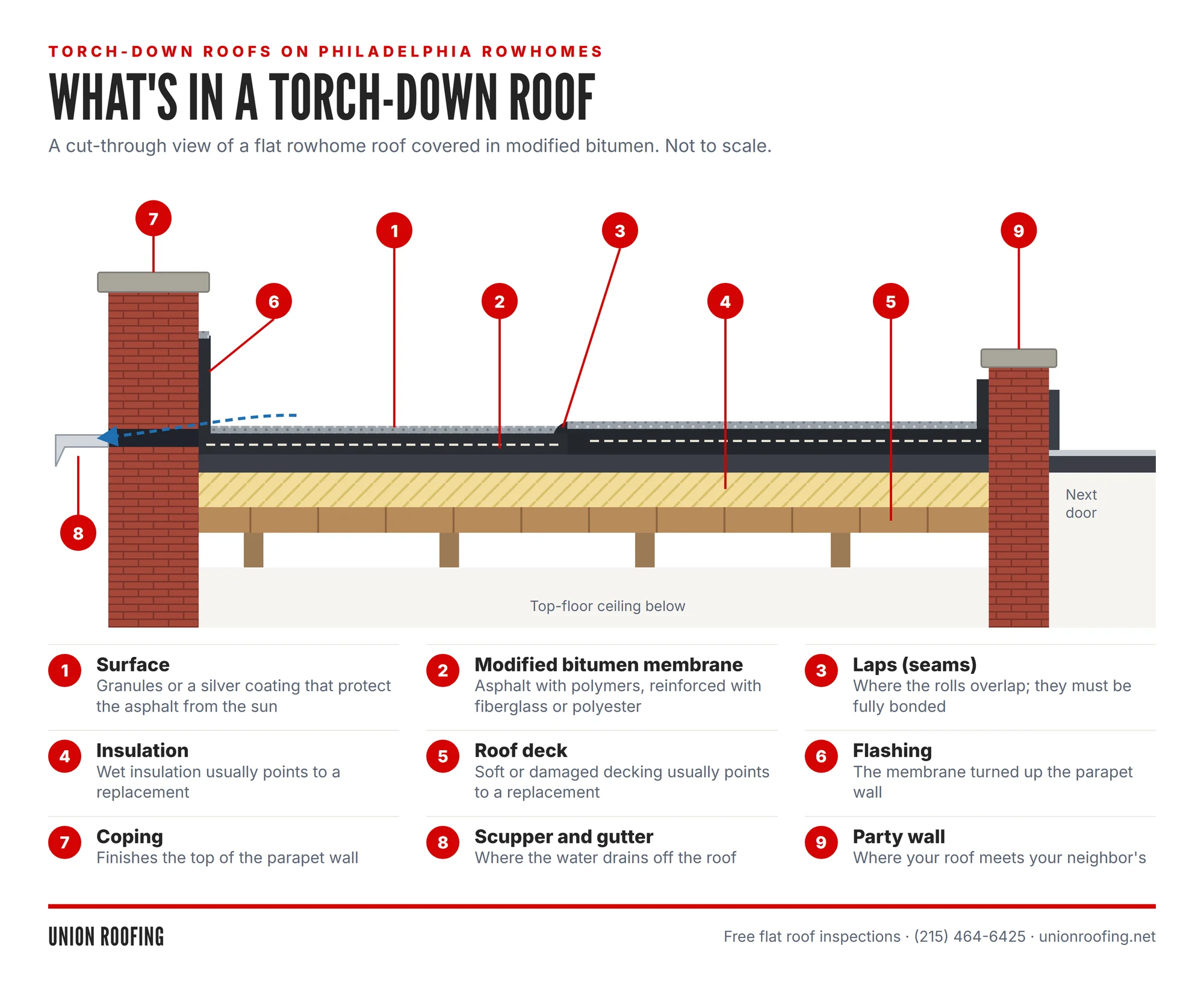
- Little slope: water drains slowly to a scupper, gutter or drain, so any blockage leaves it sitting on the roof.
- Parapet walls: the membrane turns up the wall as flashing, and the top is finished with coping. Both are common leak points.
- Shared rooflines: your roof meets your neighbors’ at the party walls, so a leak in your ceiling can start next door.
How long does a modified bitumen roof last?
Polyglass, a membrane manufacturer, says most modified bitumen roofs, whether self-adhered or heat-welded, have an expected lifespan of between 20 and 30 years, and that good maintenance can extend it further. Our modified bitumen roofing page gives a similar figure: 20 to 30 years with proper maintenance.
Polyglass names climate, installation quality, product quality and maintenance as the factors, and recommends inspections twice a year. On rowhomes, these usually shorten a torch-down roof’s life:
- Ponding water. The Asphalt Roofing Manufacturers Association (ARMA) defines ponding as water that remains on a roof 48 hours or longer, and says it may lead to accelerated erosion and deterioration of the membrane surface.
- Sun and heat. Once the granules or reflective coating wear away, the asphalt underneath tends to dry out and crack faster.
- Poor laps. Seams that were not fully bonded are often the first place water gets in.
- Foot traffic. AC servicing, dropped tools and furniture scuff and puncture the membrane over time.
What are the most common torch-down roof problems?
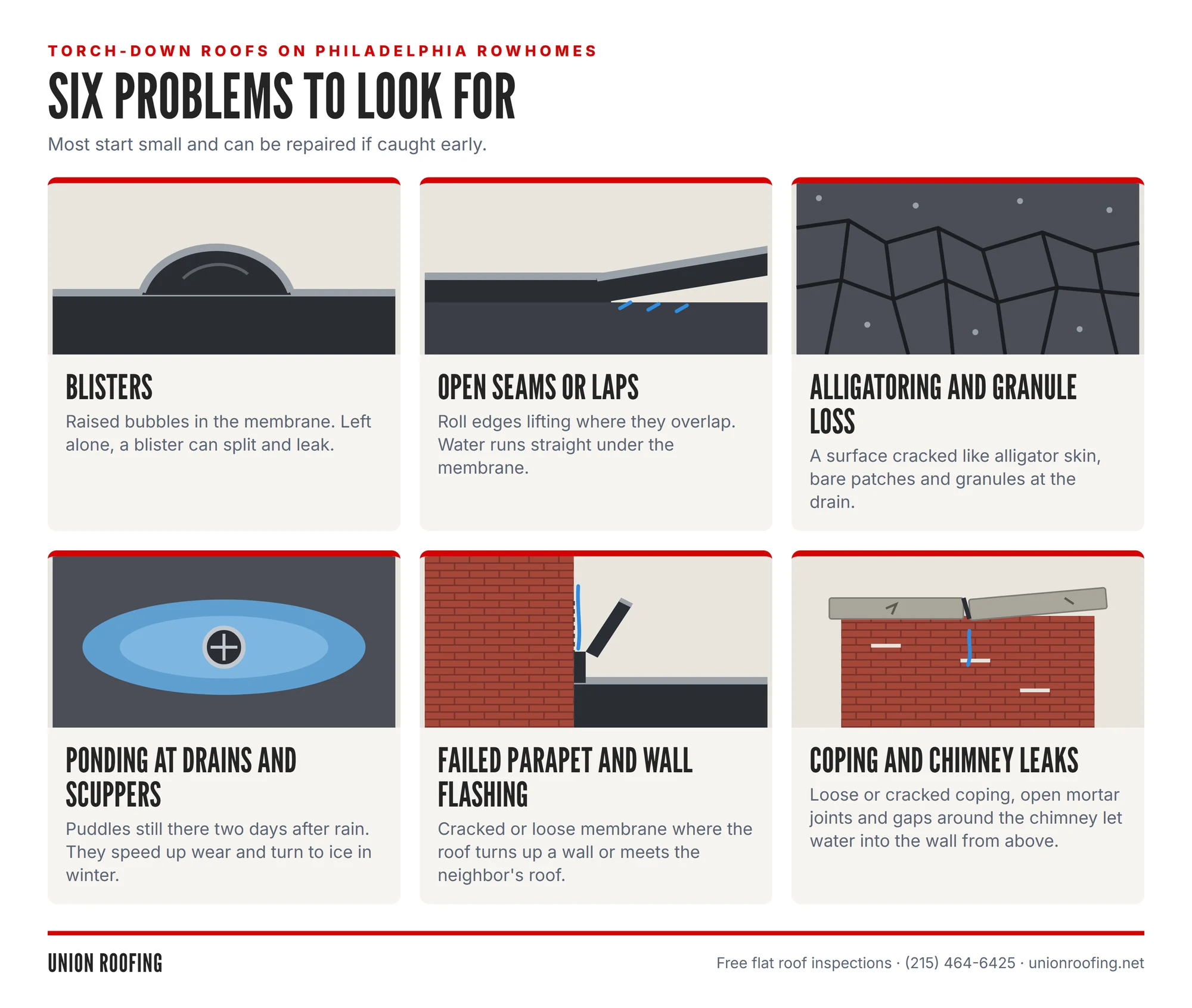
Most torch-down leaks on rowhomes come from blisters, open seams, a cracked and worn surface, ponding at drains and scuppers, and failed flashing at parapets, walls, copings and chimneys. Most start small and can be repaired if caught early, before water reaches the roof deck or the ceiling below.
| Problem | What to look for | Why it matters |
|---|---|---|
| Blisters | Raised bubbles in the membrane | Trapped moisture and heat lift the membrane; left alone, a blister can split and leak |
| Open seams or laps | Roll edges lifting where they overlap | Water runs straight under the membrane |
| Alligatoring and granule loss | Surface cracked like alligator skin, bare patches, granules at the drain | The surface is losing its protection from the sun |
| Ponding at drains and scuppers | Puddles still there two days after rain | Speeds up wear and turns to ice in winter |
| Failed parapet and wall flashing | Cracked or loose membrane where the roof turns up a wall or meets the neighbor’s roof | One of the most common flat roof leak sources |
| Coping and chimney leaks | Loose or cracked coping, open mortar joints, gaps around the chimney | Water enters the wall from above, even when the membrane is fine |
Should you repair, recoat or replace a torch-down roof?
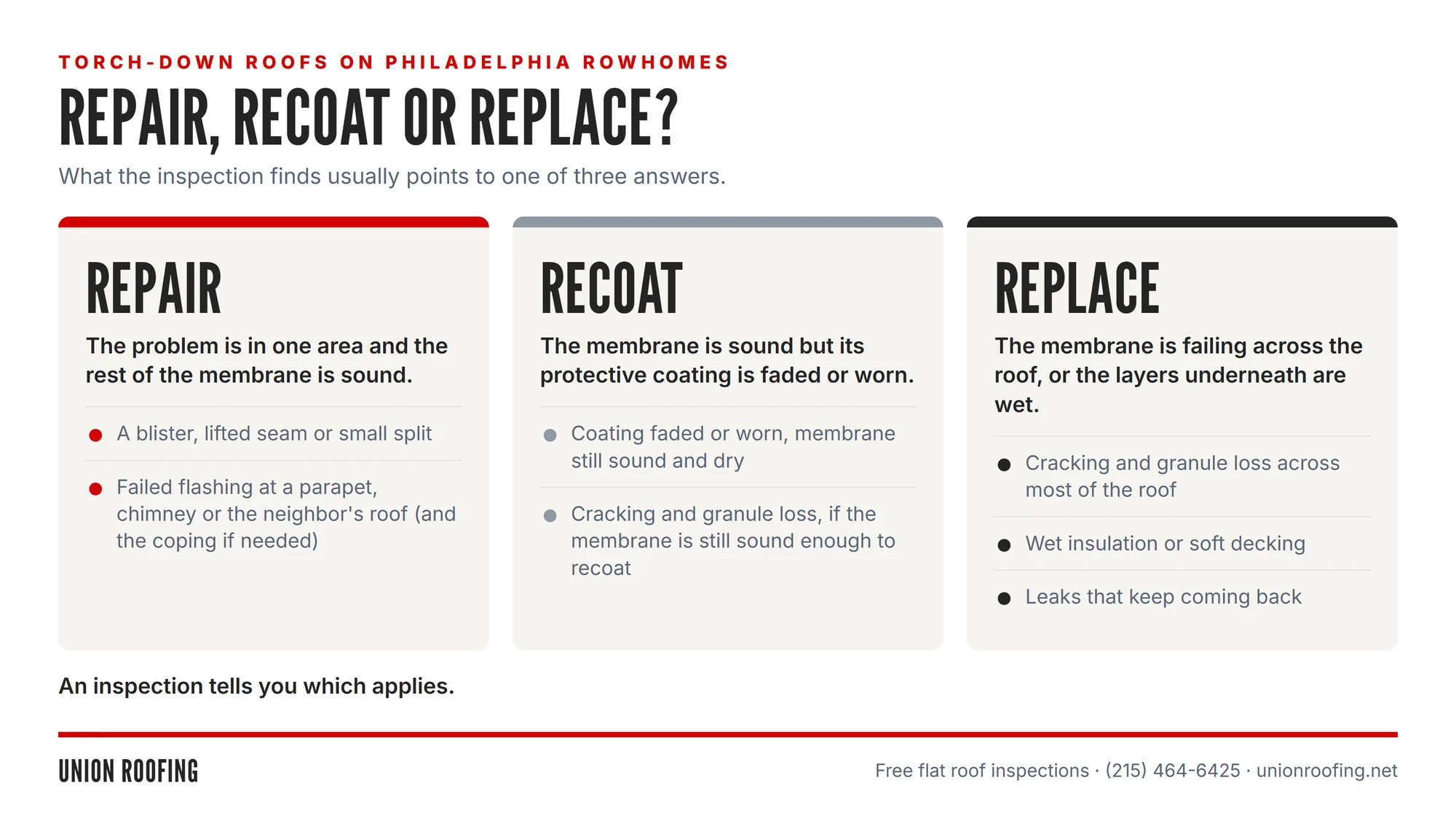
Repair when the problem is in one area and the rest of the membrane is sound. Recoat when the membrane is sound but its protective coating is faded or worn. Replace when the membrane is failing across the roof, the layers underneath are wet, or the same leaks keep coming back. An inspection tells you which applies.
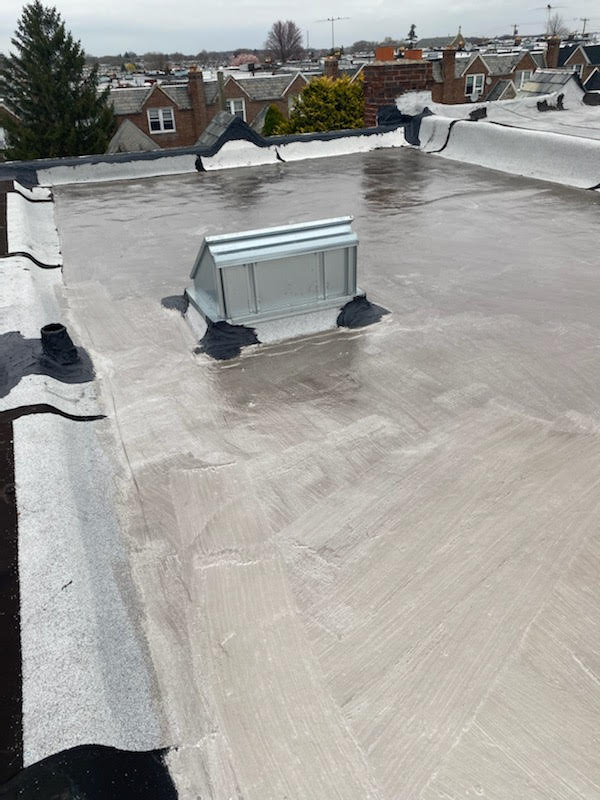
Silver-coat (aluminum coating) is a reflective layer applied over a flat roof to protect the membrane from UV and heat and reduce cooling costs. If the existing coating is faded or worn but the membrane is sound, a recoat is often a smart, affordable step.
| What the inspection finds | Usually points to |
|---|---|
| A blister, lifted seam or small split on an otherwise sound roof | Repair |
| Failed flashing at a parapet, chimney or the neighbor’s roof | Repair the flashing, and the coping if needed |
| Coating faded or worn, membrane still sound and dry | Recoat |
| Cracking and granule loss across most of the roof | Replace, unless the membrane is still sound enough to recoat |
| Wet insulation or soft decking, or leaks that keep coming back | Replace |
Coatings are one type of liquid-applied roofing. For what a new EPDM rubber roof costs, see our EPDM rubber roof cost guide.
What happens to a torch-down roof in a Philadelphia winter?
Winter is hardest on the weak spots a flat roof already has. Water in ponding areas freezes, ice builds up around blocked drains, and repeated freezing and thawing works at open seams, cracked surfaces and tired flashing. A small fall leak can become a bigger one by February, so late fall is a good time for an inspection.
ARMA notes that ice in ponded areas moves constantly with changes in temperature and can “scrub” the membrane enough to cause considerable physical damage. Before the first freeze, have drains, scuppers and gutters cleared, and get open seams, blisters and loose flashing repaired.
If your flat roof leaks during a storm
Stay off the roof: a wet or icy flat roof is slippery. Move belongings away from the leak, catch the water in a bucket, and photograph the damage. Then call (215) 464-6425 or see our emergency roofing services.
Torch-down vs EPDM vs TPO: which is right for a rowhome?
All three are proven flat-roof membranes, and each can work on a Philadelphia rowhome. Modified bitumen is a layered, asphalt-based system, EPDM is a synthetic rubber membrane, and TPO is a white, reflective single-ply membrane. The right choice depends on your roof’s condition, its drainage and how you use the roof.
| Material | Often chosen for | More detail |
|---|---|---|
| Modified bitumen (torch-down) | Durability where a roof sees foot traffic or heavy exposure | Modified bitumen |
| EPDM rubber | A tough, proven membrane that handles freeze-thaw winters | EPDM cost guide |
| TPO | Reflecting summer heat to keep top floors cooler | TPO roofing |
If your torch-down roof needs replacing, you are not tied to the same material. Ask to see the options side by side.
Torch-Down Roof FAQs
Who can repair or replace the flat roof on a Philadelphia rowhome?
Union Roofing repairs and replaces flat roofs on Philadelphia rowhomes, including modified bitumen, EPDM rubber and TPO roofs. It works from its Northeast Philadelphia office at 12260 Townsend Road and offers free estimates. Call (215) 464-6425 to book a flat roof inspection.
How long does a torch-down roof last?
Polyglass, a membrane manufacturer, puts the expected lifespan of most modified bitumen roofs at between 20 and 30 years. Drainage, sun exposure, the quality of the seams and how often the roof is inspected all affect where a roof lands in that range.
Can you walk on a modified bitumen roof?
Occasional careful walking, for example to clear a drain, is normal. Regular traffic, dropped tools and sharp objects can damage the membrane over time. If you need regular access to rooftop equipment, ask your roofer about protecting the walking route.
Can a torch-down roof be repaired in winter?
Yes. A temporary repair to stop water coming in should not wait for spring. Some permanent repairs and coatings need dry weather and temperatures within the manufacturer’s limits, so the final repair may be scheduled for a suitable day.
Is torch-down better than a rubber roof?
Neither is better for every rowhome. Modified bitumen is built in layers for durability under foot traffic, while EPDM rubber handles freeze-thaw winters well. The right choice depends on your roof’s condition, its drainage and how you use it.
Can you put a new torch-down roof over an old one?
Sometimes. It depends on how many layers are already there, whether the old roof and deck are dry and sound, building code and the manufacturer’s requirements. Wet or damaged layers have to come off first.
About Union Roofing
Union Roofing is a family-owned roofing company based at 12260 Townsend Road in Northeast Philadelphia, serving Philadelphia since 1981. It is licensed and insured, and its contractors have earned Master Elite status with GAF certification. Union installs built-up and modified bitumen roofing, repairs flat and rowhome roofs across Philadelphia, Bucks, Montgomery and Delaware Counties and South Jersey, and offers free estimates at (215) 464-6425.
Book a Free Flat Roof Inspection
Not sure whether your torch-down roof needs a repair or a replacement? Union Roofing will inspect your flat roof, find the problem and give you an honest recommendation with a free estimate. Call us, or request your free estimate online.